What the Odd Road Names Around Culcheth, Lowton, Croft and Glazebury Actually Mean
Slag Lane. Hob Hey Lane. Lately Common. Mustard Lane. Pocket Nook. Every village has a road name that makes a visitor look twice and a resident shrug. Most are older than the houses on them by several hundred years, and most mean something quite ordinary once you know the old words. Here's the lot, village by village.
First, the villages themselves.
Eilert Ekwall's Place-Names of Lancashire, published in 1922 and still the standard work, has all of them.
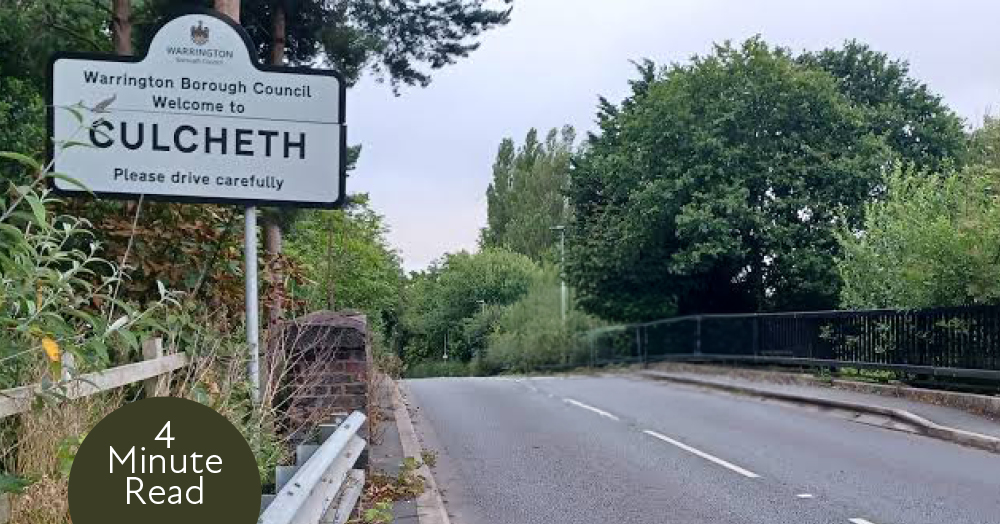
- Culcheth. Written Kulchit in 1243. It's British, older than the English, from words meaning "back" or "corner" and "wood". A retreat in a wood. There was a lot of wood.
- Lowton. Lauton in 1202. Old English hlaw, a hill or mound, plus tun, a settlement. Which is a strange name for somewhere this flat, so either the mound has gone or it was never very big.
- Croft. Crofte in 1321. A small enclosed field. The whole village is named after one field.
- Glazebury. The newest name on the list. The village grew up along the Glaze Brook, recorded as Glasebroc around 1230, and the brook's name may come from an old word for "bright". Glazebury as a village name is a Victorian invention, much younger than the brook.
- Winwick. Winewich in 1204. Wineca's settlement, a man nobody has heard of since.
- Kenyon. Kenien in 1212. Nobody is sure. Possibly British, possibly containing the Welsh name Einion.
- Risley. Ryselegh in 1284. Brushwood clearing. Birchwood, the new town built over it, was named in the 1970s after the birch woods, so the modern name and the medieval one say roughly the same thing.
- Golborne. Goldeburn in 1187. The stream where the marsh marigolds grew.
- Fearnhead. Ferneheued in 1292. The fern-covered height.
Lowton means hill. Which is a strange name for somewhere this flat.
Lowton
- Slag Lane. Slag is the waste left after smelting or burning coal, and Lowton sits on the edge of the Lancashire coalfield, with Golborne and Leigh's pits a mile or two away. A lane named for the tip beside it, in other words. It's an old name, not a modern one, and it has never stopped anyone buying a house there, which says something about how little a name matters once you live on it.
- Stone Pit Lane. Exactly what it says: the lane to the stone pit, the quarry where the village dug its building stone. Most villages had one and most have been filled in.
- Byrom Lane. From the old manor of Byrom, written de Burum around 1265, from the Old English for "at the byres", the cow sheds. Byrom Hall is still there, and the Byrom family took their name from it.
- Lane Head. The head of the lane. In a village that grew up along two main roads, the place where the side lane met the top road was a landmark before it had a name.
- Lately Common. The common land on the Lowton and Culcheth border. "Lately" has nothing to do with time. It's an old field or farm name whose first part nobody has pinned down, and the common is the open ground that survived enclosure.
- Pocket Nook. A nook is a corner of land, and a pocket is a small one. A small corner. The developers kept it, to their credit.
- Church Lane, Newton Road, Golborne Road. The lane to the church, the road to Newton, the road to Golborne. Lowton's road names are mostly honest.
Culcheth and Glazebury
- Hob Hey Lane. A "hey" or "haye" is a hedged enclosure, one of the commonest field words in Lancashire. "Hob" is either the old pet name for Robert, so Robert's enclosure, or the hob of folklore, the household goblin who did the chores if you left him milk. Both are possible and the records don't settle it. The folklore reading is the one people prefer.
- Wigshaw Lane. A shaw is a small wood or strip of woodland. The first part isn't recorded early enough to be sure; it may be a personal name or the old word for a dairy farm. Either way the wood went and the lane stayed.
- Twiss Green. Twisse in 1258, from the Old English twisla, the fork where two streams meet. Twiss Green is the green at the fork. The streams are mostly in culverts now.
- Fowley Common. Most likely fowl plus ley: the clearing where the birds were, wildfowl on the wet ground. The common is the open land that was never enclosed.
- Holcroft Lane. Holecroft in 1246. The hollow croft, the field in the dip. Holcroft Hall and the Holcroft family took their name from it, including the one whose daughter married Colonel Blood.
- Bent Lane. Bent is coarse moorland grass, the stuff that grows on mossland. Bent Lane runs across exactly that kind of ground, and the same word is in Chowbent and Chequerbent up the road.
- Daisy Bank. A bank with daisies on it. Sometimes the name is the whole story.
- Pestfurlong and Peasfurlong. Pesefurlanig in 1246. A furlong was a division of the big open field, and this was the one where the peas grew. It was one of the four quarters Culcheth was split into in 1246, and it survives as Pestfurlong Hill and Pestfurlong Moss in Birchwood Forest Park.
- Hollins Green. The green by the hollies, and the ferry: Le Fery del Holyns in 1352, when you crossed the Mersey there by boat.
Hob Hey Lane is either Robert's field or the household goblin's. The records don't settle it.
Croft and Winwick
- Mustard Lane. The obvious reading is a field where mustard was grown, which was a common crop on the mosslands and used for oil as much as for the table. We haven't found the record that proves it, so if anyone has, we'd like to see it.
- Lord Street. The lord of the manor's street. Most villages had one; Croft kept the name.
- Smithy Lane. The lane to the blacksmith's. The smithy's gone, the Horseshoe pub beside it hasn't, and the name of the pub is the same story told twice.
- Heath Lane. The lane across the heath, the rough open ground before it was drained and farmed.
- Southworth Lane. Suthewrthe in 1212. The south enclosure, from which the Southworth family took their name. The hall was at the Winwick end.
- Hermitage Green. The green by the hermitage, the hermit's cell that gave Hermitage Green its name and, in local legend, its connection to St Oswald's Well.
- Lightshaw Lane. Lightshagh in 1322. The light shaw, a thin wood or one of pale trees, on the Golborne side of Lowton.
Common Lane is named for the common, and the common is where the village centre now stands.
A few that aren't old at all. Birchwood's Oakwood, Gorse Covert and Locking Stumps were named when the new town was laid out in the 1970s, Gorse Covert on what had been site 6 of the Royal Ordnance Factory. Locking Stumps appears to have been a farm name before it was an estate, and we'd like to know what the stumps were.
And one that isn't odd but should be. Common Lane in Culcheth is named for the common land it ran across, and the common is where the village centre now stands. The precinct, the Co-op and Millennium Gardens are all on it.
If your road isn't here and the name puzzles you, tell us and we'll look it up. And if your family has been on Slag Lane for four generations and has a better explanation, we'd rather have yours.
Sources: Eilert Ekwall, The Place-Names of Lancashire (Manchester University Press, 1922), entries for Winwick, Warrington and Leigh parishes; A History of the County of Lancaster, Volume 4 (1911), via British History Online; Wikipedia, "Birchwood, Cheshire" and "Hollins Green". Where a lane name has no entry in the place-name records, the meaning given is the plain reading of the old words and is marked as such.