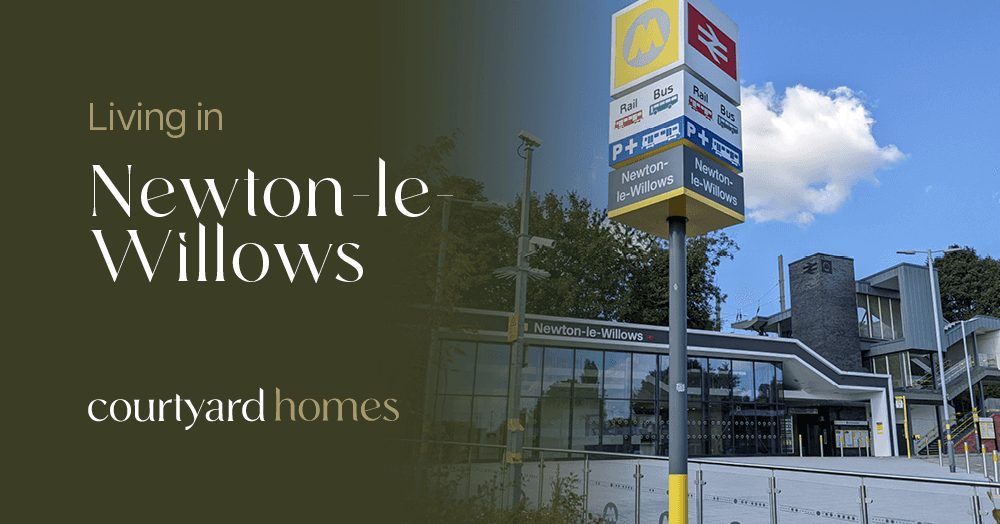
Living in Newton-le-Willows: What's Changing, and Why It Matters

Newton-le-Willows sits in the WA12 postcode on the edge of St Helens, built on canals and railways rather than farmland. It's changing fast too: a major regeneration scheme is bringing thousands of jobs to the town over the next few years.

Two places in one postcode
Newton-le-Willows and its neighbouring district of Earlestown share the WA12 postcode but have their own distinct feel. Earlestown is the older, more traditional half, built around Victorian terraces and a market that's run under royal charter since the 14th century, still busy on a Friday. Newton-le-Willows itself has a newer mix of housing alongside its historic core, with a high street that's built up a reputation for independent places to eat and drink.
What property costs
As reported by Rightmove and Zoopla in early 2026, the average property price across WA12 sits at around £185,000, a little above the wider St Helens borough average of roughly £180,000. Earlestown's Victorian terraces are the more affordable entry point, typically £120,000 to £145,000, popular with first-time buyers and investors alike. Semi-detached homes in Newton-le-Willows itself, including newer estates on the edge of town, tend to sit between £170,000 and £220,000, with larger detached and executive homes reaching £280,000 to £320,000.
Renting and yields
Average rents across WA12 were reported at around £850 a month in early 2026, up roughly 9% year on year, with gross rental yields averaging around 6.5%. Two and three-bedroom semis and refurbished Victorian terraces in Earlestown tend to be the properties in shortest supply relative to demand, largely driven by commuters wanting Manchester and Liverpool within easy reach without paying city-centre rents.
Getting around
Newton-le-Willows and Earlestown both have their own stations on the historic Liverpool to Manchester line, with direct trains to both cities. The M6 and M62 are close by, and the A580 East Lancashire Road runs through the borough too, so it works for driving as well as the train.
Schools
Families in WA12 have strong primary options directly within the town. St Peter’s CofE Primary School is a local highlight (Ofsted-rated Outstanding), while The District CofE Primary, Newton-le-Willows Primary, Lyme Community Primary, and St Mary’s Catholic Academy offer solid faith and non-faith coverage across Newton-le-Willows and Earlestown.
At secondary level, the local Option is Hope Academy in Newton-le-Willows itself, while Carmel College, an oversubscribed, Outstanding-rated sixth form and De La Salle School both serve WA12 students from nearby within the wider St Helens borough.
The regeneration worth knowing about
The former Parkside Colliery site, on the edge of the town, is being redeveloped by Langtree and St Helens Council into a logistics and advanced manufacturing hub. Government approval for the scheme has already been granted, and the plans point to thousands of jobs over the coming years, alongside the new Parkside Link Road built to support it. For landlords, that's likely to mean more tenant demand; for anyone buying, it's a sign of genuine long-term investment in the area.
What's there day to day
Newton-le-Willows' high street has quietly built a decent reputation of its own, with independent bistros,
wine bars and artisan cafes sitting alongside the everyday shops and services you'd expect. It gives the town
more of a genuine night-out-locally feel than a lot of comparable towns manage, and it's a real point in its
favour if walkable places to eat matter to you.
Haydock Park Racecourse sits on the town's edge and is one of the better-known reasons people outside the area have heard of it at all. The Sankey Valley Park, following the historic Sankey Canal, gives a proper green route through the town for walking or cycling without having to leave it.
Who it suits
First-time buyers and investors tend to look at Earlestown's terraces. Families are generally drawn by the primary schools and green space. Commuters value the direct rail links to Liverpool and Manchester. Landlords are watching yields and the Parkside jobs pipeline. And sellers are currently working in a market with steady demand behind it.
Thinking about Newton-le-Willows?
If you're buying, selling, letting or renting in WA12, we're happy to give you an honest, current read on the local market rather than figures pulled from a few months back.